Greater Consciousness
The term describes the larger reality in which consciousness may participate. It can be understood personally or more impersonally. The unknown is not presented as fully known.

Enough to understand the central ideas, the safeguards and the limits without beginning with the full sacred library.
Free introductory PDF. No declaration of belief, membership or purchase is required.
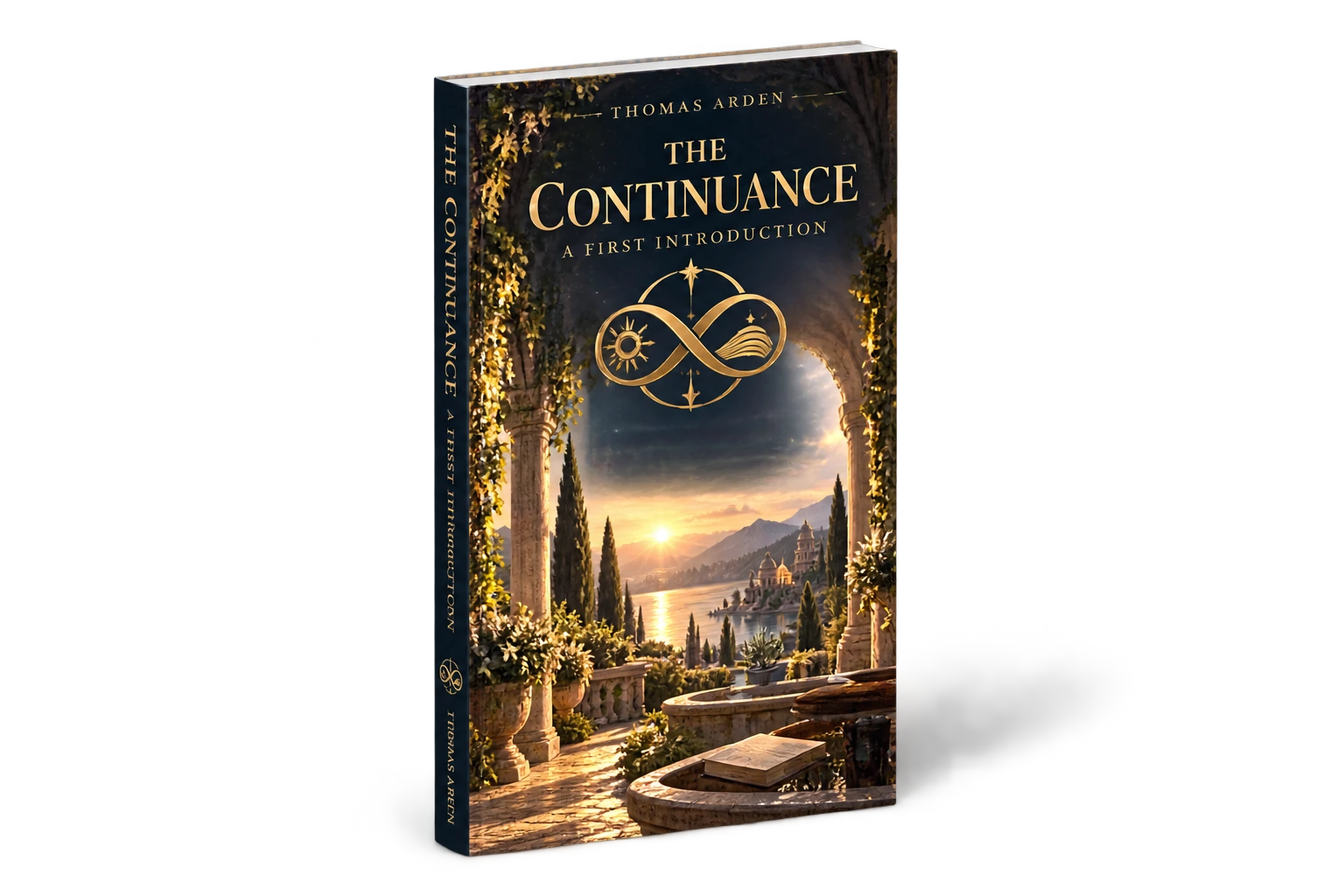
The Continuance is a modern religion founded by Thomas Arden. It holds consciousness to be fundamental and takes seriously the possibility that individual consciousness participates in a larger reality called Greater Consciousness.
It also takes uncertainty seriously. The Continuance does not claim to know the final mechanism of consciousness, the complete nature of Greater Consciousness, or exactly what follows death. It permits belief, devotion and hope without requiring people to pretend that interpretation has become proof.
Because very little of a human life ends neatly at the boundary of the individual. We inherit language, damage, kindness, laws, stories, money, habits, land, debts, knowledge and expectations. We pass things onward whether we intend to or not.
The name also leaves open the possibility that consciousness itself continues in ways we do not yet understand. That possibility is treated seriously, but not converted into certainty simply because human beings would like certainty.
What you do to another, you do to yourself.
This principle is not a metaphysical loophole through which individual people disappear. Consent still matters. Boundaries still matter. A person who causes harm remains responsible for what they did. Protection may require distance. Forgiveness does not require reconciliation.
The term describes the larger reality in which consciousness may participate. It can be understood personally or more impersonally. The unknown is not presented as fully known.
Private experience may matter deeply without becoming public proof. Scientific uncertainty is not evidence for the religion.
Guides hold structure, not spiritual rank. No private revelation gives authority over another person. Money cannot buy higher truth.
The sacred canon is called The Common Books. It contains thirty-four books and deliberately refuses a single literary form or single controlling narrator. Some books are mythic. Some are domestic. Some deal with rulers and war. Others with farming, trade, children, ageing, dying, mistakes, songs, disputed texts and people who leave.
The Common Books were created and assembled by Thomas Arden in the present age. Their long internal histories belong to the sacred literature. They are not presented as archaeological evidence for a hidden ancient religion.
Prayer may be request, gratitude, lament, intention, devotion or simply speaking into mystery. Practice also includes silence, reading, song, meals, remembrance, pilgrimage, reflection, celebration, contribution, rest and play. A practice that begins to shrink life rather than steady or enlarge it should be examined.
Children are present people, not future recruits. They may hear the stories, join meals and gatherings, ask difficult questions, refuse activities and change their minds. They are not required to declare belief in order to remain loved or included.
The Continuance does not automatically call suffering a lesson, plan or gift. It does not require the dying to provide wisdom for the people around them. It does not insist that grief become meaningful on schedule.
On what happens after death, the religion allows belief, hope, doubt and silence. Sometimes the most truthful religious answer is still: I hope so.
There is no entrance examination of metaphysical certainty. Some people may attend for years without calling themselves Continuants. Others may choose a joining ceremony because public recognition matters to them. Either is acceptable.
Friendship and family are not supposed to be conditional upon continued membership.
Go without threat. Return only if you ever wish to, and never because you are pressured.
The Continuance does not need other religions to be failed versions of itself. Nor does it treat non-believers as spiritually defective. Respect does not require pretending that real disagreements are unimportant.
The Common Books, The Book of the Continuance, The Practice Book and other full publications are paid editions. This introduction is the free starting point.